Pages

Showing posts with label Politics. Show all posts

Thursday, 27 January 2011

Posh

"In other words our politicians are already posh and about to become even posher. The meritocracy? It died around the turn of the century from a mixture of neglect and hypocrisy.  May it rest in peace, I hope it doesn't."

The concluding comments of Andrew Neil's documentary on the Westminster political class.  Well worth a watch.

Thursday, 21 October 2010

Particularism

The Assembly Public Attitude survey has been getting some attention.  (What are the odds that is going to be one of the things to be cut in the not too distant future?)  However, does it really dsiplay a particular crisis of local confidence or an example of our normality?

Sunday, 10 October 2010

Lifting from Obama?

The core reasons why I didn't like Cameron's Conference speech was he was trying to be someone else (namely Blair) and he used a number of devices what seemed to me to be from the culture of American speech-writing.  An inauthentic voice comes through in a speech.  The Mail of Sunday has confirmed the latter, arguing the Tory activist bit was lifted from a 2008 Obama speech.  Although the device is commonly used for example it is a regular feature of the State of the Union address.

Monday, 6 September 2010

Patience - Updated

The Parliamentary Voting Reform and Constituencies Bill will receive its second reading today with the Coalition leaders talking tough while others return it in kind.

The difficulty with this scenario is that it ceases to be about the bill and what it is seeking to achieve rather the political fight around it.  The core weakness of the bill is that it is trying to do too much in too short a space of time when if a degree of patience where shown in it and its associated measures the goals within it could probably be achieved. 

It would be better if the bill was held back until after the House of Lord proposals are developed and that the reform of constituencies have a target date of 2020 rather than 2015.  This will enable a rounded decision on the new structures of government and voting systems.  The roll-out of a new registration could be completed in advance of the re-drafting of the boundaries with the likely problems tackled (if Northern Ireland's experience is anything to go the likely result is less not more on the register as intended with much follow-up required).

UPDATE:  Ian James Parlsey provides a more in-depth analysis of the issues around the Coalition's Constitutional Reform programme.

Sunday, 5 September 2010

Conflicting tides

David Gordon argues there is a secular tide that Tom Elliott isn't recognising in his comments of the Gay Pride parades.  However, the picture is more complicated than that.

Besides the dumbing down of politics to symbol issues/tests, there are genuine questions how much the issue is a vote shifter and for how many here?  The growth of secularism is not the only social phenomenon going on.  While religious belief and church attendance is declining within those who do hold religious beliefs it is the smaller, evangelical and broadly more conservative churches that are growing.  Simply if people are going to believe they want something to believe in not the intellectual drift of the mainstream churches to offering very little but somewhere to go on a Sunday.  With the additional issue that such people have a good voting record.  Decisions are made by those who turn up.  Also many have chosen the option of silence on such issues but that shouldn't automatically be interpreted as support.

Beyond this electoral push and pull there is the issue of consequences.  This week CSJ produced its Breakthrough Northern Ireland report.  It provides an insight into the social costs of the social liberalism of the last 40-50 years (Note this is not how CSJ would present its work).  Granted many of these costs were unforeseen and unintended by those who proposed them but they have occurred.  So when faced with all this how should someone looking to leading act? Is compliance the only right answer?

Friday, 3 September 2010

Which 'C'?

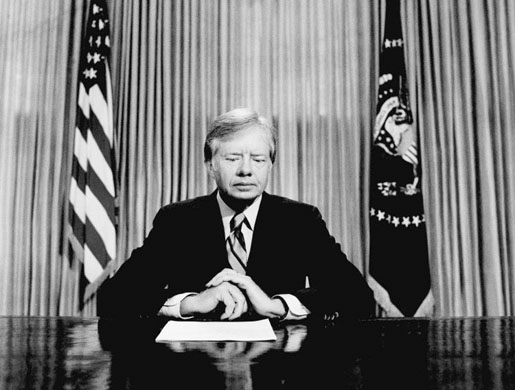
The C question has begun for Obama as the mid-term elections near.  Will he prove to be a Carter or a Clinton?  Carter being the political equivalent of Heath (or possibly Brown).  She argues that Obama of the campaign a distant memory:

"The president, for all of his success in checking off his to-do list, is now seen as just more of the same by a growing number of voters: a partisan Democrat addicted to big government and big spending.  It's strange, really, that the man who touched so many during the campaign has failed to connect in the same way during his presidency."

The polls are looking unprecendently good for the Republicans.  However, the nature of republican growth will have party bosses with significant management problems if the success comes through:
 
"...if the Republicans win handily, they'll have problems of their own: some of the newest members of Congress will be virtually unmanageable. They'll vote against every spending bill, not to mention funding the war in Afghanistan. They will have no appetite for compromise at all. They will make some GOP leaders miserable."

While Clinton played the post 94 game well he was helped by republican mis-steps.  I always thought Obama was an empty suit and never bought the Obamamania so my money has been and will remain on him proving to be a Carter.

Thursday, 2 September 2010

Judgement

Some have been questioning how Hague has responded to the press speculation about his personal life.  Guido, a pusher of the story, is maintaining a self-justifcatory pose in the face of criticism from elsewhere

"If Hague had kept an experienced press handler like William Littlejohn as his SpAd he wouldn’t be in this situation would he? He wouldn’t haven’t released that stupid statement on Monday, which brought him more unwanted press attention. He wouldn’t have released that cynical, Aitkenesque, “sword of fidelity” statement yesterday. All in all, he has only himself to blame for being ill-advised and has shown a staggering lack of judgement."

The media class certainly seems shocked by Hague's intervention yesterday.  However, perhaps more surprising is John Redwood's intervention:

"Let us hope this is now an end to the matter. Mr Hague himself now seems to believe that it was poor judgement to share a hotel room with an assistant."

Wednesday, 1 September 2010

Excruciating

The other day I blogged how Ross Perot quote about politics.  The excruciatingly personal statement that Hague has had to issue is an example of the quote's veracity. 

Monday, 30 August 2010

The squeezed middle

Tim Montgomerie highlights an interesting piece by Mary Ann Seighart about how Labour can work its way back electorally.  It begins with the premise that:

"if anyone is going to bear the financial brunt of the new austerity under this government, it is likely to be middle-income voters."

She highlights how media misdefinition has hampered understanding of who the middle is in the UK:

"I say "middle-income" rather than "middle-class" deliberately, for there is a notorious tendency among well-paid metropolitans to assume that the middle classes are simply people like them."

She highlights how this misdefinition then results in bad suggestions:

"Median gross annual earnings in 2009 were £20,801. That is not a lot of money. These people are unlikely to say, airily: "I really don't deserve child benefit. I ought to donate it to Water Aid." Tax credits, introduced by Labour, have helped them enormously, and they dread losing that buffer against debt. They fear for their jobs and, if they are close to retirement, they know they will rely on the winter fuel allowance to be able to pay their heating bills."

The flippant manner in which introducing water charges is talked about by some is perhaps a local example of this mentality.  The desire for 'progressive' cuts intensifies the effect on people in the middle income bracket:

"The Liberal Democrats are keen to make the cuts as progressive as possible, which means targeting middle-class benefits...If Iain Duncan Smith is to find the money needed to help ease the transition from welfare to work, he can hardly raid benefits for the poor while keeping them for the middle classes. One way or another, then, it is middle-income voters who will lose out."

After a range of policy ideas (some good and some bad) this leads to the conclusion that:

"So the left-right divide at the next election is likely to be between one party arguing for a universal welfare state in which people who put money in can expect to get something out, and two parties arguing for a pared-down version that only helps those in need. In that case, Labour would be campaigning for the middle classes and the Coalition for both the poor and the rich. If you thought coalition government threw up unexpected political alignments, you ain't seen nothing yet."

Perhaps the Sun is attuned to this income group with its displeasure at the no tax cuts in this term talk. 

However, there is a potential timing issue with this theory and how much the dire talk is an exaggeration. If the Coalition goes the distance an election is 4 and a half years away if the economy has recovered by then what has been cut may not be as much of the debate as it is now.  Also its good policy right now to be a doom and gloom merchant.  It can be an attempt to establish a 'virtuous'cycle and show clear purpose to the money markets that the issue of the deficit is taken seriously.  Yet the lesson from other countries tends to be that doom and gloom doesn't prove to be as bad as expected with a strong recovery.

For example, the Treasury predictions of this year's deficit proved to be over-estimation of nearly £20 billion.  While it's too soon to make definitive statements on growth (and the American economy looking dodgy is a cause for concern) we have achieved more growth in the first six months than the official prediction for the entire year.

Hence it could very well get better sooner than people expect increasing the Coalition's options in advance of an election.  The squeeze could have been eased before people go to the ballot box in a Westminster election but to get there the Coalition has to hold together through some bad election results particularly next year.  The potential for a split in the Liberal Democrats is real although the scale of it would determine whether the government could continue or make a deal with a smaller party.

Friday, 27 August 2010

Democracy costs money

The Telegraph's is trying to claim that buying tables at a Tory business dinner equates to:

"...controversial fund-raising methods employed by Labour under Tony Blair."

Leaving aside the fact that cash for honours was in a different league entirely with potential criminal activity involved, it does raise the issue of party finances.  Allastair Campbell recently remarked that the political class needs to start standing up for itself. Hardly an easy ask in the post expenses climate but in that spirit here goes.  

Everyone agrees that democratic politics costs money but no one wants to pay for it (at least not to the levels that are needed).  Like most other mass membership organisations party political membership is down.  This means two things - less membership income and less volunteers to do the work.  So a party either cuts back or employs people - the former leads to complaints and a lose of contact that is bad for voting turnout and the latter to increased costs (and to some of the previous as the number of employees hasn't matched the drop in volunteers).

The culture of dontating to political parties is not especially well-developed in the UK (and NI especially) and does not compare with the United States of America (neither are there tax breaks for donations here).  Granted organisations can sometimes update their systems and approaches but it rarely matches what is needed.

This then leads to the public option - parties are funded out of the public purse to some level.  This does happen but it is not something that tests well with the public and the idea of more certainly doesn't.  Also monies for the public's benefit e.g. constituency offices and staffing get lumped in as party political income when it isn't (it is also unfairly lumped in as a politician's personal income).

This leads parties to the interest group route whether that be trade unions, particular causes or the private sector.  With this comes the accusation that the parties are in hoc to their demands and the demand as in the Telegraph piece that such things stop.  This overlooks three checks and balances on that:
  • Freedom of information - More information on how are government works can be accessed so the likelihood of exposure if this is true has grown.
  • Free press - Cash for access, cash for honours, expenses etc were all exposed by the media.  Their is a watchdog and it does bark and bite.
  • Votes - If people view a politician or party to be in hoc to one group to their detriment then they can vote for someone else.
Essentially the tri-partite system of fundraising is a reasonable mix with the first needing more effort put in with the internet a possible means to re-engage volunteers but chopping off any of the three legs is not sensible.

Thursday, 26 August 2010

The pesky brain

Two articles worth having a look at about the human brain and politics.  Via slugger you get to a University of Michigan how a person of a particular political belief will be reinforced in their position even when shown the facts that reinforced it are incorrect.  Via conservativehome you get to research on neuroscience that demonstrates how party preference can lead to a reversal of position on a policy issue.  This has significant impact on how a political message is developed.

Saturday, 17 July 2010

It's all been done before

The national election in Australia has been called and the incumbent Labor Party has revealed it's party slogan, "Together, let's move Australia forward":

Now that has a familiar ring to it,oh yes:
And ahem.

Wednesday, 14 July 2010

An Alternative Media Strategy

Sarah Palin may be the person liberal America loves to hate but the New Republic has an interesting piece of how she has developed a highly successful media strategy to maintain public prominence following the failed McCain campaign and her resignation as Alaska Governor.  At its heart is new media:

"Her byline pops up now and again in the opinion pages (supporting McCain, bashing enviros). She periodically hits the campaign trail with favored candidates. She is a prolific and passionate tweeter. Her Facebook page overflows with thoughts on global events both past (DDay, Reagan’s Brandenburg Gate speech) and present (Israel, border security, the need to drill, baby, drill); news of upcoming appearances (a rally at the Lincoln Memorial with Glenn Beck, a possible U.K. jaunt to meet Margaret Thatcher); the latest media atrocities committed against her; and her rolling endorsements of “commonsense conservative” candidates who tickle her fancy. And, any day now, filming is scheduled to start on the docu-travelogue series in which Palin will “bring the wonder and majesty of Alaska” to TLC viewers."

It argues that it suits her own personality:

"It suits her core strengths—passion, pithiness, and a mind-boggling magnetism—and, let’s face it, it’s so much easier than the conventional model."

Also that despite the dismissal of her abilities, it is a strategy that she may well be the creator of:

"Any political strategist who orchestrated such brilliant success via such unconventional means would instantly be dubbed the p.r. genius of our time. But, as far as we know, there is no crack communications team charting Palin’s course. At some point, even Palin haters may have to face the possibility that the p.r. genius is Sarah herself."

UPDATE Spectator Blogger Alex Massie has a blog on the topic of Sarah Palin and a run in 2012.  He says:

"...she's not been playing the game according to the Beltway Playbook but that's exactly the point"

He points to a recent Time article which makes the point that unorthodox approaches is the way Palin does things:

"In many ways, Palin's moves mirror her run for governor. She came from the outside, taking down the GOP establishment, including the formidable Governor Frank Murkowski. She stayed on the outside for months, not bothering to build a campaign but delivering key speeches across the state attacking “the old boys club” that raised speculation she'd potentially run. And, finally, when she did announce her campaign burst into life fully formed."

Monday, 24 May 2010

Glamour and politics

A problem in the political culture and intellectual climate of Northern ireland is the tendency for the first answer to be "Government needs to do something". One personal means of trying to escape from that is my subscription to Reason magazine, a libertarian magazine from the USA. However, the most interesting article is this month's issue is not about the size of government but rather the role of glamour in politcs (sadly not online).
In an interview, Virginia Pastrel argues (unsurprisingly) that President Obama's glamour factor helped him get elected. it defines glamour as:

"...a particular form of illusion. It's an illusion that tells a truth about the audience's desires, and it requires mystery and distance."

This illusion and projection of individual desires leads to a dangerous tendency as regards lying:

"Lying is usually a bad thing, but they would would project onto him that he was lying about his positions because he secretly agreed with them: "Anyone that smart has got to be a free trader at heart. He's just saying this to pander to those idiots. He can't really mean it.""
However, the power of being elected on glamour comes at two costs. First, a decision for the candidate to chose between maintaining the glamour and getting things done:

"You've seen, as he's taken office and tried to govern, this back and forth where he is consciously or unconsciously trying to maintain his glamour - which requires a kind of distance from the political process so that people can continue to see him as representing them."

Second, is the flip side of a person who fell for the glamour:

"...there is always this capacity for disillusionment. People have projected so much of what they think, including things that are sort of impossible, onto a glamourous figure, that when any flaw shows up the glamour is dispelled and suddenly he becomes terrible."

Postrel's blog which examines the role of glamour in society is here.